

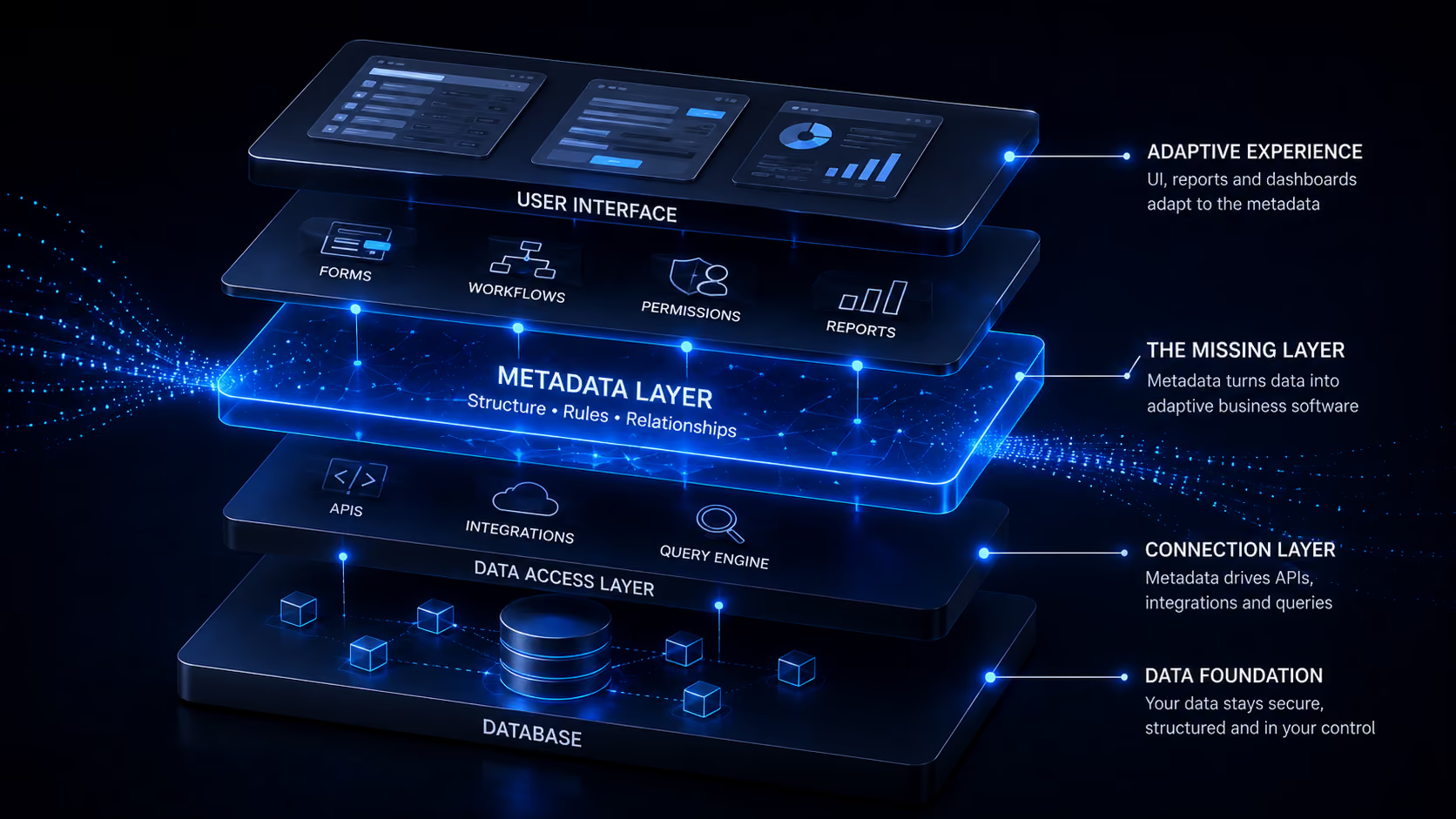
For decades, business software has followed the same fundamental pattern.
Developers write application code.
That code defines the database, user interface, workflows, permissions, business rules and reports.
If the business changes, developers change the code.
It has been a remarkably successful model.
It is also one of the biggest reasons why enterprise software struggles to adapt.
What if the software didn't need to be rewritten every time the business evolved?
What if much of the application's behaviour could be described rather than programmed?
That is the idea behind metadata-driven architecture.
What Is Metadata?
The word metadata simply means data about data.
Most people encounter metadata every day without realising it.
A photograph contains information about when it was taken, which camera captured it and even the GPS location.
A music file stores the artist, album and track number.
A document records its author and creation date.
None of this information is the content itself.
Instead, it describes the content.
Business software can work in exactly the same way.
Instead of hard-coding behaviour into an application, we can describe how the application should behave using structured information.
The application simply reads those definitions and behaves accordingly.
Hard-Coded Software
Traditional enterprise applications usually contain logic like this:
- Customer has a Name field.
- Orders belong to Customers.
- Sales Managers approve discounts.
- Invoices become read-only after posting.
These rules are embedded directly inside the application.
Changing them usually requires development work.
Even relatively small changes often involve:
- modifying source code;
- updating database structures;
- changing user interfaces;
- testing integrations; and
- deploying new software.
The more customisations a business requires, the larger this cycle becomes.
Metadata-Driven Software
Now imagine the same application behaves differently.
Instead of programming:
Customers have these fields.
The platform reads a definition saying:
Customer consists of Name, Account Number, Credit Limit, Industry, Territory and Preferred Language.
Instead of programming:
Sales Managers approve discounts.
The platform reads a workflow definition describing who approves which values.
Instead of programming forms, reports and permissions individually, the platform generates them from metadata.
The software becomes an execution engine rather than a collection of fixed applications.
One Change, Many Results
The real power appears when a single metadata change automatically affects multiple parts of the system.
Imagine adding a field called:
VAT Registration Number
A traditional application may require developers to:
- update the database;
- modify APIs;
- update forms;
- modify search;
- change reports;
- update validation;
- write migrations; and
- test every affected screen.
A metadata-driven platform can potentially generate many of these changes automatically.
One definition updates every layer consistently.
This significantly reduces duplication and the likelihood of inconsistencies.
Why This Matters
Businesses evolve continuously.
They introduce new services.
Expand internationally.
Acquire competitors.
Change regulations.
Launch subscriptions.
Adopt AI.
Traditional software treats each of these changes as another development project.
Metadata-driven systems treat many of them as configuration.
That changes the economics of software development.
Instead of repeatedly modifying the same application, organisations invest in improving the platform itself.
Developers Become More Valuable
A common misconception is that metadata-driven platforms reduce the need for developers.
The opposite is usually true.
Developers stop spending time on repetitive customisations.
Instead they build:
- reusable components;
- workflow engines;
- reporting frameworks;
- integrations;
- security;
- APIs;
- AI capabilities; and
- specialist modules.
Their work benefits every solution built on the platform.
Rather than writing similar code hundreds of times, they build capabilities once and reuse them everywhere.
Consultants Become More Strategic
Consultants also benefit.
Instead of documenting requirements that programmers later translate into code, consultants increasingly work directly with configurable business models.
Their expertise shifts towards:
- business analysis;
- process optimisation;
- implementation strategy;
- organisational change; and
- industry-specific best practice.
Technical knowledge remains valuable.
Business knowledge becomes even more valuable.
Where AI Fits
Artificial intelligence makes metadata-driven platforms even more powerful.
A business user might simply say:
Create a customer onboarding workflow requiring manager approval, automatic contract generation and a follow-up after thirty days.
AI can translate that request into structured metadata.
The platform validates it.
Developers define the platform's capabilities.
Consultants verify the business process.
The result combines automation with governance rather than replacing human expertise.
The Challenges
Metadata-driven architecture is not a magic solution.
Building the platform itself is significantly harder than building a single application.
The platform must:
- remain secure;
- perform efficiently;
- support extensions;
- manage upgrades;
- validate configurations; and
- remain understandable for users and developers alike.
Designing that architecture requires considerable engineering experience.
However, once the platform exists, every future application becomes easier to build.
That is why so many modern software platforms are moving in this direction.
Looking Ahead
Business software is gradually shifting away from fixed applications towards adaptable platforms.
Metadata-driven architecture provides one of the foundations for that transition.
It enables software to evolve alongside businesses rather than forcing businesses to wait for software.
As artificial intelligence becomes increasingly capable of generating structured metadata, the pace of software development may accelerate dramatically.
The future may involve writing less application code and describing more business behaviour.
Conclusion
Metadata-driven architecture is not simply another software development technique.
It represents a different way of thinking about business software.
Rather than embedding every decision into application code, organisations define how their systems should behave using structured metadata.
The platform interprets those definitions and generates much of the resulting behaviour automatically.
For businesses, this promises greater flexibility.
For consultants, more strategic work.
For developers, more reusable engineering.
And for the future of enterprise software, it may prove to be one of the most significant architectural shifts in decades.


