

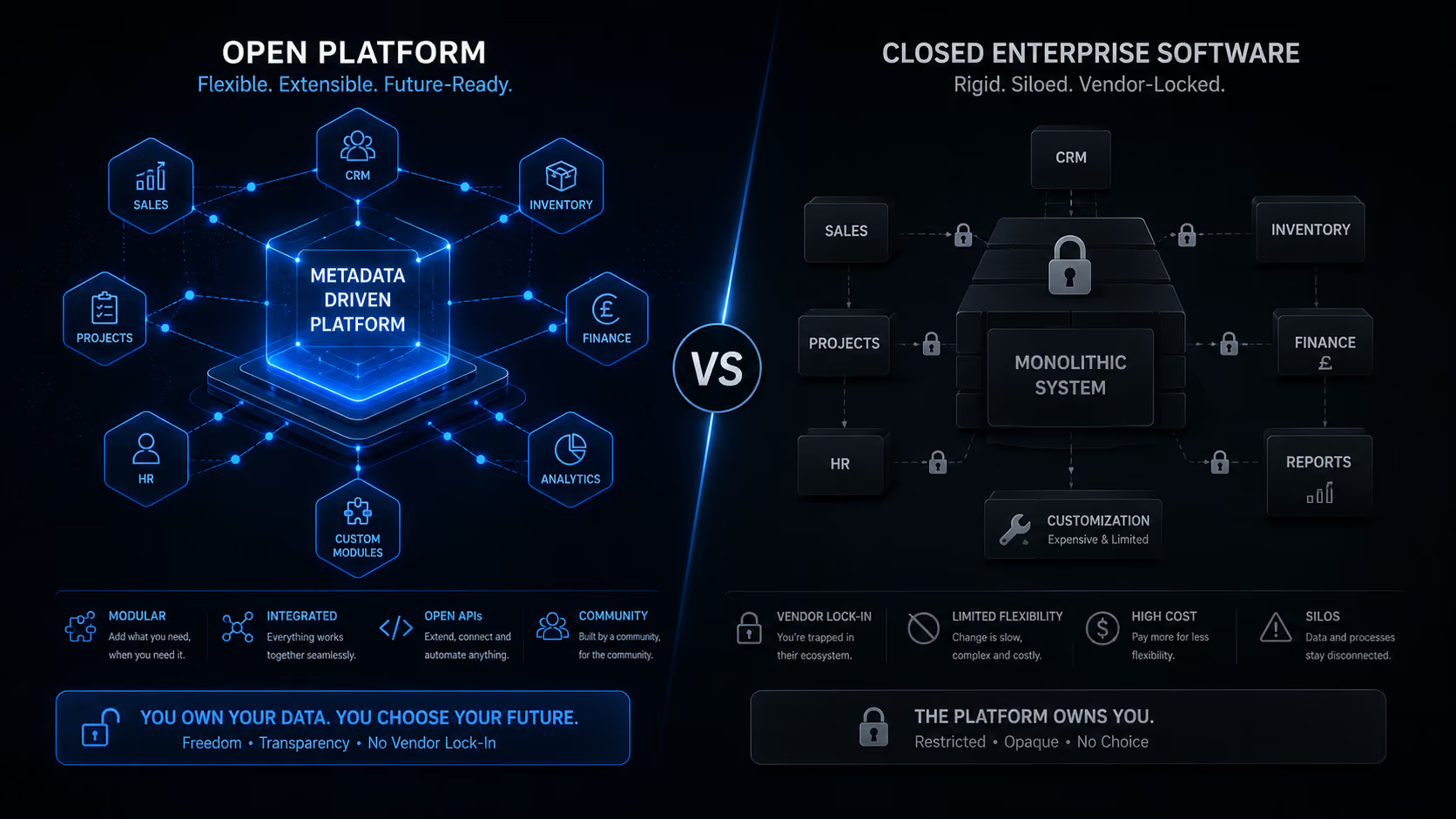
Enterprise software customers rarely choose a product for only its current features.
They are also choosing a long-term relationship with a vendor, technology stack, data model and ecosystem.
That relationship can last for decades.
Closed platforms often provide a polished, integrated experience. The vendor controls the product, infrastructure, extension model and release process. For many organisations, that simplicity is valuable.
The difficulty appears when the organisation's needs diverge from the vendor's direction or when leaving becomes prohibitively expensive.
Open platforms attempt to preserve more choice. But openness is not a single feature, and it does not automatically produce better software.
Understanding the trade-offs requires looking beyond the label.
What Makes Enterprise Software Closed?
A closed platform is controlled primarily by one vendor.
Customers may be able to configure it extensively, use APIs and purchase third-party extensions. They do not control the underlying product or the terms under which access continues.
Closed systems can restrict customers in several ways:
- The software may run only in the vendor's cloud.
- Data exports may omit relationships or historical detail.
- Extensions may require proprietary tools.
- APIs may be limited, priced separately or changed by the vendor.
- Custom modules may work only inside the vendor's marketplace.
- Licence terms may restrict modification or independent hosting.
None of these characteristics makes a platform inherently unsuitable. They do increase dependency on the vendor.
Why Closed Platforms Are Attractive
Closed platforms succeed because central control can create real advantages.
One company can coordinate design, security, hosting, support and product direction. Customers have a clear organisation to hold accountable. Updates can be delivered consistently across the installed base.
A managed cloud service also removes infrastructure work from the customer.
For organisations that fit the standard model and value convenience over control, a closed platform may be a sensible decision.
The risk is not the existence of control. It is the absence of credible alternatives when circumstances change.
Vendor Lock-In Is More Than Data Export
Discussions about lock-in often focus on whether data can be exported.
Data portability is essential, but it is only one layer.
An organisation may be able to download tables while still being unable to reproduce the behaviour of its system elsewhere.
The real investment includes:
- Data structures and relationships.
- Workflows and approval rules.
- Reports and calculations.
- Permissions and security policies.
- Integrations with other systems.
- Custom modules.
- Training and operational knowledge.
If these definitions cannot be inspected or transferred, the organisation remains dependent even when raw data is available.
What Openness Should Mean
An open business platform should provide practical freedoms rather than rely on branding.
Data freedom
Customers can export complete data in documented formats, including relationships and relevant history.
Deployment choice
The platform can support vendor-hosted cloud services, private cloud or self-hosted environments where appropriate.
Extension freedom
Developers can build modules using documented interfaces and standard technologies.
Transparency
Important platform behaviour, schemas and extension contracts are documented and inspectable.
Commercial choice
Customers can obtain services from different consultants and developers rather than being restricted to one supplier.
Exit paths
Moving away may still require work, but it remains technically and contractually possible.
Open Source Is Important but Not Sufficient
Open source can provide transparency and reduce dependence on one vendor.
However, access to source code does not automatically create a viable alternative.
A complex platform may require specialist knowledge, proprietary hosted services or an ecosystem that exists only around the original provider.
A project can be open source yet difficult to operate independently.
Conversely, a platform may offer strong data portability and extension rights while keeping some managed services proprietary.
The practical question is whether customers retain meaningful control, not whether every line of code uses the same licence.
Openness Requires Standards
Open ecosystems work best when components communicate through stable, documented standards.
APIs, events, metadata schemas and package formats allow modules to participate without private knowledge of the platform's internals.
Standards also reduce the risk that openness leads to fragmentation.
Developers need enough freedom to innovate while still following contracts that preserve compatibility and security.
A platform that exposes its internals without defining reliable extension points may be technically open but operationally fragile.
The Security Trade-Off
Closed vendors often argue that central control improves security. There is truth in that claim.
A smaller set of approved components is easier to govern than an unrestricted extension ecosystem.
Open platforms must therefore treat security as an architectural responsibility.
- Modules should declare permissions.
- Sensitive operations should pass through governed services.
- Updates should be signed and traceable.
- Vulnerabilities should have coordinated disclosure and response processes.
- Customers should be able to restrict which sources they trust.
Openness should not mean that any code can access any part of the system.
The Innovation Trade-Off
Central product teams can move quickly when they control every layer, but they must prioritise across all customers.
Open ecosystems allow specialist innovation to occur independently.
A developer can create an integration for a regional service. A consultant can package an industry workflow. A customer can commission a capability without waiting for the core vendor's roadmap.
The platform gains breadth from the ecosystem.
The cost is greater coordination: compatibility, quality assurance, discovery and support all become more complex.
A Sustainable Open Platform Still Needs Revenue
Openness is sometimes confused with the absence of commercial value.
Reliable business software requires ongoing investment in engineering, security, documentation, hosting and support.
An open platform can charge for managed hosting, subscriptions, enterprise services, verified modules, support or marketplace transactions.
The distinction is that payment buys a service or capability rather than removing the customer's future choices.
A sustainable model is essential. An abandoned open project offers less practical freedom than a healthy commercial platform.
How Businesses Should Evaluate a Platform
Before selecting enterprise software, organisations should test the vendor's claims about flexibility.
- Can all business data be exported in a usable form?
- Are APIs documented and included in the normal commercial model?
- Who owns custom modules and configurations?
- Can another supplier maintain the implementation?
- What happens if the vendor changes pricing or product direction?
- Can the system run in another environment?
- Are workflows, permissions and metadata inspectable?
- How are third-party modules governed and updated?
These questions reveal more about long-term control than a feature comparison alone.
A Balanced Model
The choice does not need to be between a completely closed service and an unsupported collection of open-source components.
A balanced platform can offer the convenience of a managed service while preserving open data, documented extensions and deployment options.
Customers can choose the vendor's cloud because it is convenient, not because the system becomes unusable anywhere else.
Developers can sell modules without preventing customers from understanding or replacing them. Consultants can compete through expertise rather than privileged access.
This model aligns commercial success with customer value rather than dependence.
Conclusion
Closed enterprise platforms can provide consistency, convenience and clear accountability. Their weakness is the concentration of control.
Open platforms can provide portability, extensibility and a broader ecosystem. Their challenge is maintaining quality, security and commercial sustainability.
The best long-term architecture may combine both strengths: a professionally managed platform built on open contracts, portable data and genuine extension rights.
Businesses should not need to sacrifice convenience to retain control of the systems on which they depend.