

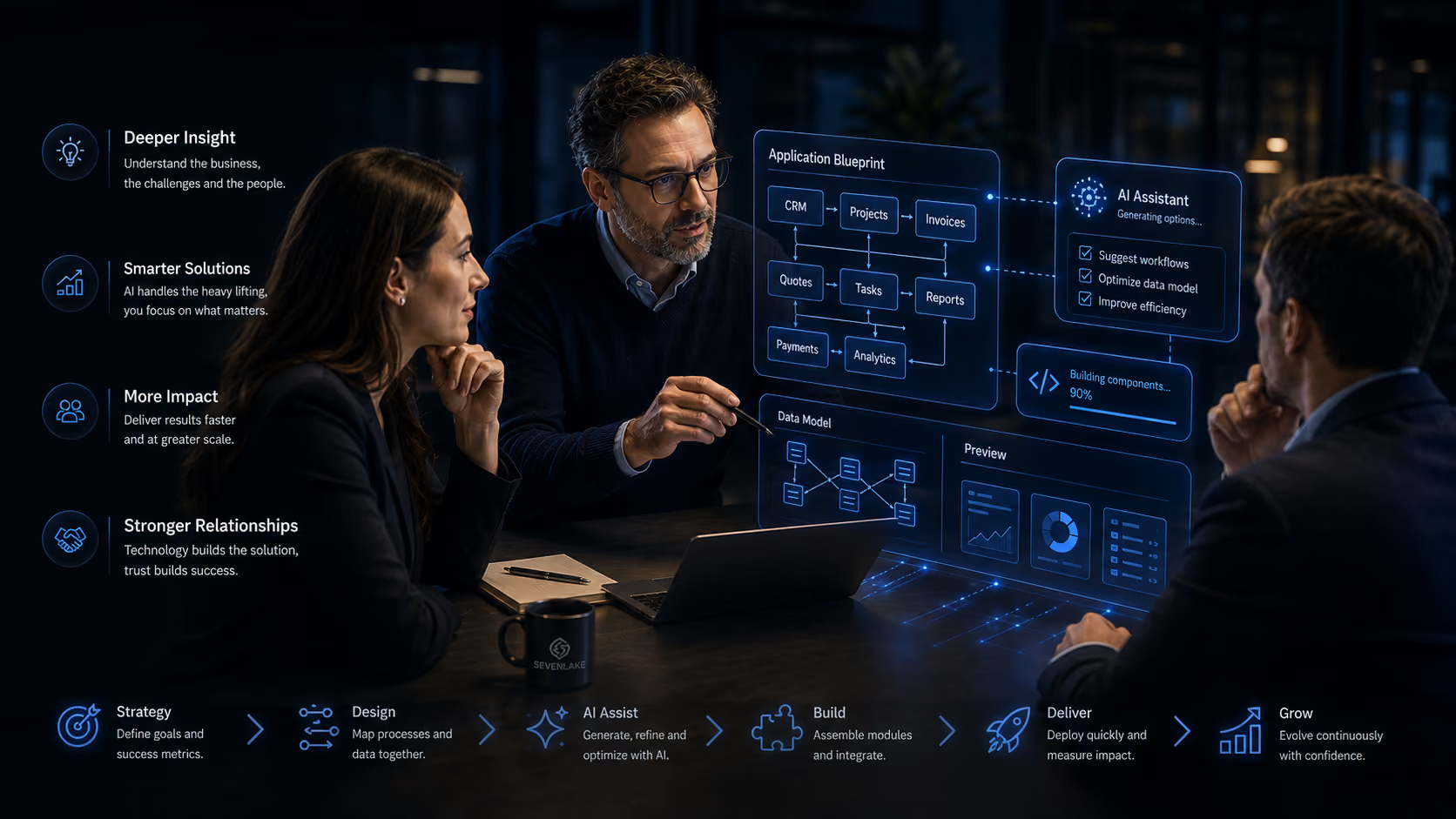
Artificial intelligence is changing software work quickly enough to make almost every professional reconsider their role.
Software consultants are no exception.
Tools can already summarise requirements, draft process maps, generate code, configure applications and answer technical questions. It is reasonable to ask whether clients will still need consultants when AI can perform more of the implementation work.
The answer depends on what we believe consultants are actually paid to do.
If consultancy consists mainly of copying settings between systems and producing routine documents, a significant part of that work will be automated.
If consultancy means understanding an organisation, challenging assumptions, designing workable processes and taking responsibility for change, AI is more likely to increase the consultant's value than remove it.
The Visible Work Is Not the Whole Job
Clients often see the outputs of consulting: workshops, specifications, configurations, reports and training materials.
Behind those outputs lies a less visible process.
- People describe the same process differently.
- Departments optimise for conflicting goals.
- Important requirements remain unstated because staff assume they are obvious.
- Legacy workarounds are mistaken for essential business rules.
- Management ambitions do not always match operational reality.
- Data exposes inconsistencies that nobody wants to own.
A consultant's value lies partly in finding and resolving these contradictions before they become software problems.
AI can assist with the analysis, but it does not automatically possess the context, authority or trust required to negotiate a solution.
Requirements Are Not Simply Collected
Traditional project language often suggests that requirements already exist and merely need to be gathered.
In reality, requirements are developed through discussion.
A sales manager may request a mandatory approval step. Operations may explain that the step would delay urgent orders. Finance may need an audit trail but not a manual approval in every case.
The final process emerges through judgement and compromise.
AI can surface alternatives and identify patterns. A capable consultant still needs to understand the consequences, ask difficult questions and help the organisation make a decision.
Business Context Is Local
Two companies using the same accounting rules can operate very differently.
Their customers, risk tolerance, staff experience, products, culture and regulatory obligations all influence which solution will work.
Generic best practice is useful, but it is not a substitute for local understanding.
Consultants learn how work really happens by observing exceptions, informal communication and the points where employees leave the official system to complete a task.
That context determines whether a technically elegant design will succeed in practice.
AI Will Remove Repetitive Implementation Work
A large amount of traditional implementation work is repetitive.
- Creating standard fields and forms.
- Mapping similar data structures.
- Drafting test cases.
- Producing first versions of documentation.
- Configuring common workflows.
- Explaining familiar product features.
- Generating routine reports and queries.
AI-assisted and metadata-driven platforms can perform much of this work faster.
That should be welcomed rather than resisted.
Consultants rarely create their greatest value by spending hours reproducing standard configuration. Automation frees them to focus on the decisions that require experience.
The Consultant Becomes a System Designer
As platforms become more adaptable, consultants can work at a higher level.
Instead of translating every requirement into a ticket for developers, they can help define the organisation's data model, process model and control framework directly.
AI may generate an initial solution from those definitions. The consultant can review whether it reflects the intended business outcome.
This shifts the role from product configuration towards system design.
The consultant becomes responsible for coherence across processes, people, data and technology.
The Consultant Becomes a Curator
Future platforms will offer growing libraries of modules, templates, connectors and AI-generated options.
More choice does not eliminate the need for expertise. It increases the need to select carefully.
A consultant can evaluate whether a reusable module is mature, secure and appropriate for the client's circumstances. They can distinguish between a useful shortcut and an attractive component that introduces long-term risk.
They can also combine standard modules with targeted extensions rather than recommending either a rigid package or a fully bespoke system.
Trust and Accountability Still Matter
Business software affects invoicing, payroll, inventory, customer service and regulatory compliance.
When an organisation changes these systems, it is not merely experimenting with technology. It is changing how people perform their jobs.
Senior leaders need someone who will explain trade-offs clearly, identify risks and remain accountable when the project becomes difficult.
AI can provide analysis. It cannot independently hold a relationship, accept professional responsibility or lead a difficult organisational conversation.
Consultants who build trust will remain valuable even when the underlying tools become dramatically more capable.
Change Management Becomes More Important
Faster software creation does not guarantee faster organisational change.
A platform may generate a new workflow in minutes, but employees still need to understand why it exists, how responsibilities have changed and what happens when exceptional cases occur.
When software becomes easier to modify, organisations may be tempted to change it continuously.
Consultants can help establish governance so that flexibility does not become instability. They can plan releases, gather feedback, manage training and ensure that improvements remain aligned with strategy.
Industry Knowledge Becomes Reusable
Consultants accumulate patterns across projects.
They learn which controls are essential in a particular industry, which reports managers genuinely use and which implementation mistakes recur.
Metadata-driven platforms can turn that knowledge into reusable assets.
A consultant might package an onboarding process, compliance workflow or specialist reporting model as a module or template. It can then be adapted for future clients rather than rebuilt from the beginning.
This creates a more scalable consulting model and gives experienced practitioners a way to earn from their intellectual property.
What Consultants Need to Learn
The role will change, and consultants who rely entirely on product-specific configuration may feel pressure.
The most valuable skills will increasingly include:
- Business process analysis.
- Data modelling and information governance.
- Integration and platform architecture.
- AI-assisted solution design.
- Security and permissions design.
- Change leadership.
- Commercial understanding.
- Module and template productisation.
Technical literacy remains important, but memorising the location of settings inside one vendor's product becomes less defensible as a career advantage.
A More Productive Partnership
The strongest model is not AI instead of consultants.
It is AI, consultants and developers working at the right levels.
AI accelerates analysis and implementation. Consultants define intent, resolve ambiguity and guide change. Developers build the reliable platform, specialist modules and safeguards that make automation useful.
Each group contributes something the others cannot provide alone.
Conclusion
AI will replace some consulting tasks. It is unlikely to replace the role of a trusted consultant who understands both organisations and technology.
As routine configuration becomes automated, the remaining work becomes more strategic: designing coherent systems, managing risk, helping people change and turning experience into reusable solutions.
The consultants who embrace these tools will not become less valuable. They will be able to deliver better outcomes with less repetitive effort—and serve more organisations without lowering the quality of their work.