

An open-source business rules engine can move important decisions outof scattered application code and into explicit, testable rules. Thatcan make policies easier to review, change and reuse across severalapplications.
But installing a rules library does not automatically make businesslogic understandable. A successful implementation needs clear ruleownership, a suitable representation, reliable input data, versioning,tests, approval and an explanation of every significant result.
This guide explains when a rules engine is useful, when ordinary codeis better and how to compare open-source approaches including Drools,OpenL Tablets, GoRules ZEN Engine, Microsoft RulesEngine andjson-rules-engine.
What is a business rulesengine?
A business rules engine evaluates facts against defined conditionsand produces outcomes or actions.
For example:
If the customer is active, the order value exceeds £10,000 andavailable credit is insufficient, require credit-manager approval.
The input facts might include customer status, order value and creditexposure. The output could be an approval requirement, reason code andresponsible role.
Rules engines are commonly used for:
- Eligibility decisions.
- Pricing and discounts.
- Credit and risk classification.
- Product or service configuration.
- Validation.
- Routing and approvals.
- Fraud indicators.
- Tax or fee calculations.
- Compliance checks.
- Operational prioritisation.
The engine separates the decision logic from the code that gathersinputs, presents interfaces, stores records and carries out theresult.
Rules engine, decisionengine or BRMS?
The terms overlap, but they describe different scopes.
TermMain purposeRules engineExecutes conditions and actions against supplied factsDecision engineEvaluates a defined decision model and returns a resultBusiness rules management system (BRMS)Adds authoring, repository, versioning, testing, deployment,permissions and governance around rulesWorkflow engineCoordinates a sequence of tasks, events and waiting states overtime
A library may execute JSON rules inside one application. A full BRMSmay allow analysts to edit decision tables, submit changes for approvaland deploy governed rule versions to several services.
Do not buy a governance platform when a small embedded library isenough. Equally, do not expect a lightweight evaluator to provide audit,approvals and business-user authoring that it was never designed todeliver.
Why use anopen-source business rules engine?
Make important logic visible
Business rules often become dispersed among screens, API handlers,database procedures, integrations and spreadsheets. Nobody can easilyanswer which version represents the current policy.
A shared rule definition can create a single, reviewable source for adecision.
Change ruleswithout rebuilding unrelated code
If the rule representation and deployment model support it, a pricingthreshold or eligibility condition can be changed independently of theapplication's presentation layer.
That does not mean business users should change production ruleswithout engineering controls. The benefit is separation and controlleddeployment—not uncontrolled editing.
Reuse decisions acrosschannels
The same decision service can support a website, internalapplication, mobile app and batch process. This reduces the chance thateach channel interprets the policy differently.
Explain outcomes
A well-designed rule system can record the input facts, rule-setversion, matched conditions and resulting decision. That is valuable forsupport, audit and appeals.
Retain technical control
Open-source software can provide access to the execution engine,licence terms and deployment model. It may allow embedding orself-hosting without dependence on a proprietary decision service.
However, the surrounding editor, repository, governance tools orcommercial support may use different licences. Evaluate the completesolution, not only the core engine.
When not to use a rulesengine
A rules engine introduces another language, runtime and operationalresponsibility. It is not the best home for all conditional logic.
Keep logic in ordinary code when:
- The condition is simple, stable and local to one component.
- The behaviour is primarily technical rather than a businesspolicy.
- Developers are the only people who need to understand or changeit.
- The decision cannot be separated cleanly from side effects and statechanges.
- The rule engine would make debugging harder rather than easier.
- There is no governance process for externally stored rules.
For example, rejecting a malformed API request is usually applicationvalidation. Choosing an insurance excess from many interacting policyconditions is more likely to justify a decision model.
Do not create a rule for every if statement.
Rules, workflowsand processes are different
A decision answers a question from supplied facts:
Does this order require approval?
A workflow manages work over time:
Send the approval to the credit manager, wait for a response,escalate after two days and notify sales.
The rule engine can determine that approval is required and perhapswhich level. The workflow engine should normally manage people, waiting,escalation and completion.
Mixing long-running workflow behaviour into decision rules makes bothharder to understand and test.
How should businessrules be represented?
The best representation depends on the people who own the rule andthe complexity of the decision.
Decision tables
Decision tables arrange conditions and outcomes in rows and columns.They work well when a decision depends on a manageable set of discretecriteria.
Customer tierOrder valueCredit positionResultStandardUp to £5,000Within limitAutomatic approvalStandardAbove £5,000Within limitSupervisor approvalAnyAny valueOver limitCredit-manager approval
Tables can expose gaps, overlaps and unintended combinations moreclearly than a long sequence of nested conditions.
Decision trees and graphs
Decision trees help when questions have a natural sequence.Decision-requirements graphs show how several smaller decisions andinput sources combine into a larger decision.
The Object Management Group's Decision Model and Notation standardprovides notation and a modelling language for specifying businessdecisions and rules. It is designed to be understandable to businessusers, analysts and technical teams and to complement processmodelling.
Textual rule languages
Text formats suit developer-managed rules, complex matching andsource-control workflows. They can be concise and expressive but may bedifficult for business owners to validate without supporting views andexamples.
JSON or structured documents
JSON-based rules are easy to store, transmit and embed in modernapplications. They can work well for small decision services andmulti-language architectures.
Human readability depends on the schema. A document can be valid JSONwhile still being an opaque collection of nested operators.
Spreadsheets
Spreadsheets are familiar and effective for tabular decisions, butfamiliarity can conceal risk. Add schema validation, controlledtemplates, type checking, version control and automated tests. Do notexecute arbitrary business spreadsheets directly in production.
Requirements for areliable rules platform
Explicit inputs and outputs
Define a stable decision contract. Specify field names, types, units,allowed values and treatment of missing information.
orderValue: 10000 is ambiguous without a currency.customerAge: 18 may be insufficient if a rule depends onthe date and jurisdiction at which age is calculated.
Deterministic behaviour
The same facts and rule version should normally produce the sameresult. Pass dates, exchange rates and reference data explicitly ratherthan reading changing external values invisibly during evaluation.
Effective dates
Business policies change. Store when a rule becomes valid and, whereneeded, when it ceases to apply.
Historical decisions should be reproducible using the rule andreference data that applied at the time—not recalculated silently usingtoday's policy.
Rule ownership
Each significant rule set needs a business owner who can confirmmeaning and approve changes. Developers should not have to invent policywhen implementation exposes an ambiguity.
Versioning and approvals
Treat rules as production assets. Record:
- Who changed the rule.
- Why it changed.
- The previous and new versions.
- Review and approval.
- Test evidence.
- Deployment time and target environments.
- Rollback route.
Explanation and audit
For material decisions, store:
- Decision identifier.
- Time of evaluation.
- Input facts or a stable reference to them.
- Rule-set version.
- Outcome and reason codes.
- Relevant matched rules.
- Calling application.
Avoid logging sensitive input indiscriminately. Audit design mustalso respect privacy and retention requirements.
Testing business rules
A rules engine makes logic external, but it does not make the logiccorrect.
Use example-based tests
Every important rule should have examples covering:
- Normal cases.
- Exact boundary values.
- Values just below and above boundaries.
- Missing or invalid facts.
- Conflicting rules.
- Effective-date changes.
- Unexpected combinations.
For a threshold of £10,000, test £9,999.99, £10,000 and £10,000.01.The words “above”, “at least” and “exceeds” must translate intodeliberate operators.
Test decision tablesfor gaps and overlaps
A gap exists when no rule handles a possible input combination. Anoverlap exists when several rules match and the result depends onpriority or conflict resolution.
Some engines can analyse decision tables. Drools, for example,documents static analysis of DMN decision tables for gaps and overlaps.Apache KIE: DMN
Use historical and syntheticcases
Replay representative past decisions to detect unintended changes.Add synthetic cases for new boundaries and combinations not present inhistorical data.
Historical agreement is not proof of correctness if the old rule waswrong. It is evidence that should be reviewed with the businessowner.
Compare versions beforerelease
Run old and proposed rule versions against the same case set. Explainevery changed result. This is particularly useful for pricing,eligibility and risk classification.
Architecture andintegration choices
Embedded engine
The rule engine runs inside the application process.
Advantages:
- Low network latency.
- Simple local deployment.
- Application and rules can be released together.
Concerns:
- Each application may load different rule versions.
- Updating rules may require redeployment.
- Multi-language organisations may need several bindings.
Central decision service
Applications call a shared service through an API.
Advantages:
- One governed decision endpoint.
- Rules can be updated independently of clients.
- Consistent behaviour across applications.
Concerns:
- Network dependency and latency.
- Service availability becomes critical.
- Versioning is required so clients do not break when contractschange.
Distributed rule packages
Approved rule packages are published to applications or edgelocations.
This combines local execution with central governance, butdistribution, compatibility and rollback must be designed carefully.
Choose the model based on availability, latency, governance andconsistency—not on architecture fashion.
Open-sourcebusiness rules engines compared
The projects below represent different approaches. Verify currentlicences, releases and commercial edition boundaries beforeadoption.
EngineMain approachOften worth considering whenDroolsJava-based inference rules, DRL, decision tables and DMN decisionservicesComplex Java decision systems need expressive rules orstandards-based DMN supportOpenL TabletsSpreadsheet-based tables with BRMS capabilitiesAnalysts need to author tabular rules in a familiar documentstyleGoRules ZEN EngineCross-platform JSON decision models with native bindingsPortable embedded decision execution across several languages isimportantMicrosoft RulesEngineJSON rules using C# expressionsA .NET application needs a lightweight, extensible rule libraryjson-rules-engineJSON conditions and events for JavaScriptA Node.js or browser project needs relatively lightweight structuredrules
This is not a performance ranking. The right engine depends on therule model, authors, runtime, governance and operationalrequirements.
Drools
Drools is a mature open-source decision and rule platform centred onthe Java ecosystem. Its documentation describes forward- andbackward-chaining inference, a native rule language and a DMN decisionengine. Droolsintroduction
Drools may fit when:
- Rules involve matching and inference across many facts.
- Java is central to the application stack.
- DMN support is required.
- The team needs decision tables as well as textual rules.
- Developers can manage the additional concepts of working memory,rule activation and conflict handling.
Check:
- Whether a simpler decision table or expression evaluator would beeasier.
- How rule ordering and conflicts will be controlled.
- Which authoring and management components will be used.
- How rules will be tested, packaged and deployed.
- The skill level needed to diagnose unexpected firing behaviour.
Drools' power is valuable for suitable problems but can beunnecessary complexity for a small set of deterministiccalculations.
OpenL Tablets
OpenL Tablets describes itself as an open-source business rulesengine, BRMS and decision-management system. Its main approachrepresents business logic through table formats, including decisiontables, lookup tables, decision trees and spreadsheet-like calculations.OpenL Tablets:What is OpenL Tablets? OpenLTablets: Getting started
It may fit when:
- The decision is naturally tabular.
- Business analysts are comfortable working with spreadsheet-likedocuments.
- Rules need to remain close to existing business documentation.
- Java or service-based integration is acceptable.
- Explainability and review of tables are important.
Check:
- Template and type controls around rule spreadsheets.
- Repository, testing and approval workflows.
- How non-tabular logic will be represented.
- The operational process for deploying rule changes.
- Current project activity, support and licence terms.
The spreadsheet format can improve participation, but only whenediting is controlled as carefully as source code.
GoRules ZEN Engine
ZEN Engine is an open-source engine written in Rust that evaluatesJSON Decision Model documents. Its repository lists native bindingsacross several languages, while the wider GoRules offering addscommercial BRMS functions. ZENEngine repository GoRulesarchitecture
It may fit when:
- The same decision model must run in different languageenvironments.
- JSON-based portability is useful.
- An embedded engine or headless decision service is preferred.
- The team wants to separate the open execution engine from optionalmanagement services.
Check:
- The difference between the engine, visual editor and commercialBRMS.
- Governance functions required in your chosen deployment.
- Compatibility of rule-model versions across bindings.
- Explanation and audit output for your use case.
- How rule packages will be stored, approved and distributed.
Microsoft RulesEngine
Microsoft RulesEngine is an MIT-licensed .NET library for storingrules outside application core logic. It supports JSON rule definitionsand C# expressions. MicrosoftRulesEngine
It may fit when:
- The project uses .NET.
- Developers manage the rules.
- JSON storage and C# expressions are appropriate.
- A lightweight library is preferable to a full BRMS.
Check:
- How expressions will be secured and reviewed.
- Whether business owners can understand the rule representation.
- What repository, approval, audit and deployment functions must bebuilt around it.
- How expression changes will be tested against representativecases.
This is an execution library, so do not assume it supplies a completebusiness-user governance environment.
json-rules-engine
json-rules-engine is a JavaScript rules library using JSON structureswith nested all and any conditions, priorityand event results. It can run in Node.js and browsers. json-rules-enginerepository
It may fit when:
- The application is JavaScript or TypeScript based.
- Rules are relatively small and event-oriented.
- JSON persistence is useful.
- Developers want an embeddable library without a full BRMS.
Check:
- Browser exposure of rule logic and sensitive facts.
- How rules are validated and governed.
- Whether rule priorities can create hidden dependencies.
- Explanation, versioning and effective-date requirements.
- Whether execution belongs on the server rather than the client.
A practical selectionprocess
1. Choose a real decision
Select a bounded but representative rule set. Avoid both a trivialage check and the organisation's most complicated policy as the firstexperiment.
2. Identify the rule owners
Establish who understands, approves and changes the policy. Theirneeds should influence the representation and governance model.
3. Define the decisioncontract
Specify typed inputs, outputs, reason codes, error behaviour,effective dates and audit needs.
4. Model the rules in twoforms
Try the leading alternatives—for example, a DMN decision table and aJSON rules model. Compare clarity, not just whether each canexecute.
5. Build tests beforeintegration
Create boundary, gap, overlap, missing-data and historical cases.Confirm the expected results with the business owner.
6. Test change and rollback
Change a rule, review the difference, approve it, deploy it to a testenvironment and restore the previous version.
7. Test explanation
Ask someone outside the implementation team to explain why a sampledecision occurred using only the captured decision evidence.
8. Assess operations andcommunity
Review current releases, security policy, maintenance activity,documentation, licence, upgrade path and available support.
How Sevenlake plansto treat business rules
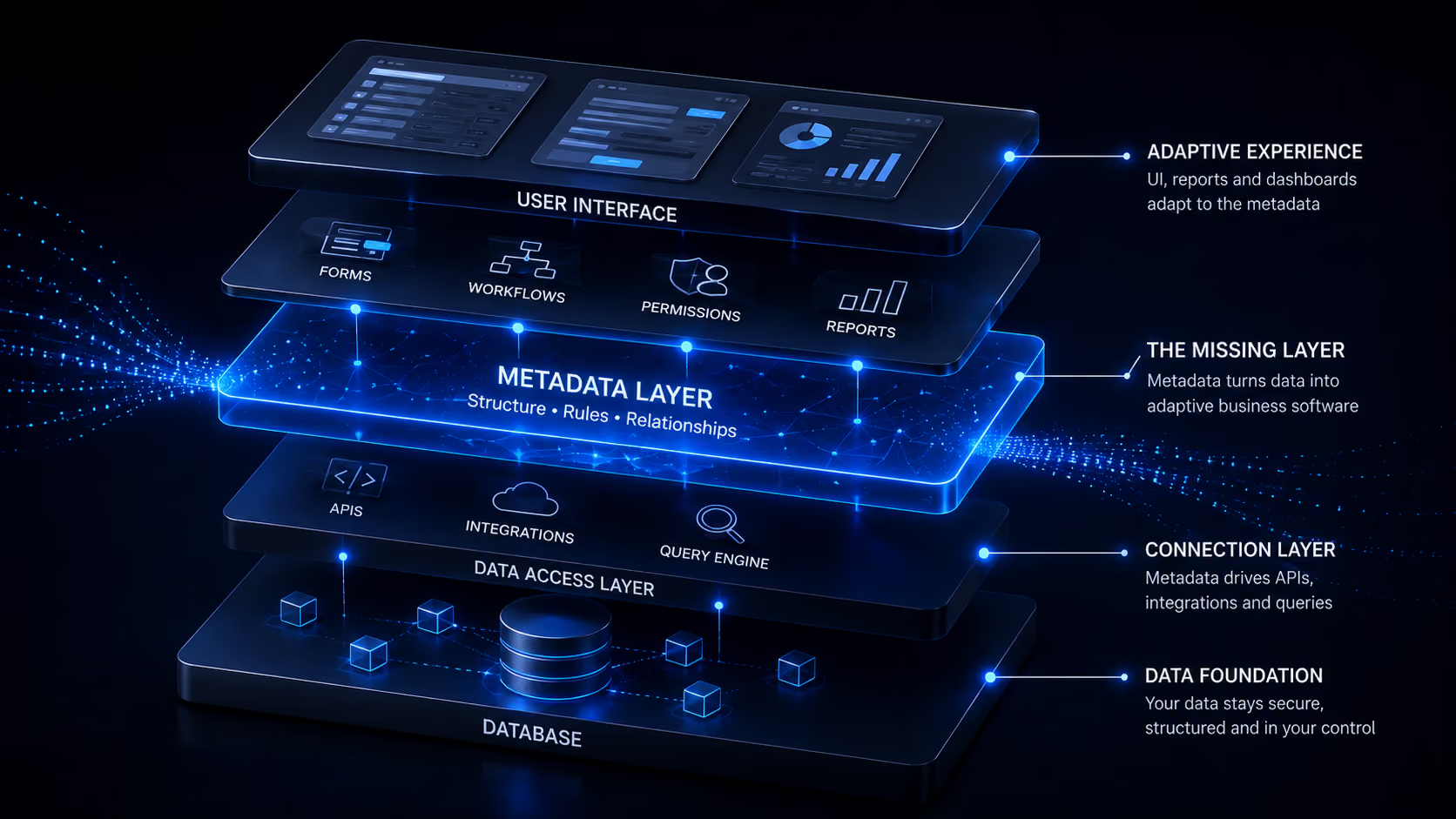
Sevenlake's metadata-first direction creates an opportunity to makebusiness rules part of the structured application definition rather thanscattering them throughout generated interfaces and custom code.
The intended approach is that rules could eventually be:
- Defined as structured metadata.
- Connected explicitly to the data entities and processes theygovern.
- Reused across interfaces, APIs, imports and workflows.
- Presented in forms that business specialists and developers canreview.
- Versioned, tested and deployed as application assets.
- Used by AI assistance within a controlled application model.
This would help an AI-assisted builder work with explicit rulesrather than infer policy repeatedly from prompts or existing sourcecode. It could also make the effect of a proposed change easier toanalyse across an application.
Important design questions still need to be resolved, including rulerepresentation, execution semantics, conflict handling, permissions,effective dating, testing and audit. Sevenlake has not yet released aproduction rules engine, visual editor or BRMS.
The project is currently at the vision and architecture stage, movingtowards a proof of concept. Any rules capability should therefore bedescribed as part of the intended platform direction, not as anavailable feature.
Frequently asked questions
What is thebest open-source business rules engine?
There is no universal best option. Drools suits complex Java and DMNscenarios; OpenL Tablets suits spreadsheet-style rule authoring; ZENEngine suits cross-language JSON decision models; Microsoft RulesEnginesuits .NET; and json-rules-engine suits lightweight JavaScript use. Testthe exact rule set and governance process.
Arebusiness rules engines only for large enterprises?
No. A small embedded library can be useful in a modest applicationwhen important rules change independently of the code. A full BRMS maybe unnecessary for a small team.
Can businessusers edit rules without developers?
They can with suitable authoring tools, but production changes shouldstill use validation, testing, review, approval and rollback. Ease ofediting must not remove control.
Is a decision table a rulesengine?
A decision table represents rules. An engine interprets or compilesthe table and evaluates it against input data. A table can also beimplemented directly in code or a database, but then the team mustprovide the execution and governance behaviour.
Whatis the difference between DMN and a proprietary rule language?
DMN is an OMG standard for modelling decisions and business rules.Proprietary or project-specific languages may provide differentcapabilities but can increase migration effort. Standards supportportability in principle, but actual compatibility between tools shouldstill be tested.
Should rules be stored ina database?
They can be, provided the format is validated, versioned and deployedsafely. Directly editing live database rows without review and testingcreates operational risk.
Can AI create business rules?
AI can assist in extracting, drafting and testing rules, butaccountable business owners must confirm policy meaning. Generated rulesshould never bypass validation, approval and representative testing.
Keep the decision visible
An open-source business rules engine is most valuable when itimproves understanding and control, not merely when it relocatesconditional logic from one file to another.
Begin with a decision that changes often or must be shared acrossapplications. Define its inputs, outputs, owner and examples. Choose arepresentation that the right people can review. Build versioning,tests, explanation and rollback around the engine from the start.
Sevenlake is exploring how structured business rules could becomereusable parts of metadata-defined ERP, CRM and operationalapplications. If that direction interests you, explore Sevenlake fordevelopers, view the publicroadmap or follow developmenton GitHub.