

For many organisations, implementing an Enterprise Resource Planning (ERP) system is one of the largest technology investments they will ever make.
The expectation is simple.
A modern ERP system should integrate departments, improve efficiency, reduce manual work and provide better visibility across the business.
Sometimes it does.
Yet many ERP projects still exceed their budgets, miss their deadlines or fail to deliver the expected benefits.
The reasons are rarely as simple as choosing the wrong software.
Most ERP failures have far deeper architectural and organisational causes.
ERP Projects Have Become Increasingly Complex
Modern businesses are far more complex than they were twenty years ago.
A typical organisation now operates across multiple locations, sells through several channels, integrates with dozens of external systems and must comply with an ever-growing list of regulations.
An ERP system sits at the centre of all these activities.
It manages customers, suppliers, inventory, purchasing, manufacturing, finance, reporting and increasingly connects with CRM systems, e-commerce platforms, AI services and third-party applications.
Trying to model every one of these requirements before a project begins is an enormous challenge.
Every Business Is Different
ERP vendors often describe their software as supporting "best practice."
That is partly true.
Many accounting processes are similar.
Inventory management follows common principles.
Purchasing generally works in predictable ways.
The difficulty begins where organisations differentiate themselves.
A manufacturer may have a unique production process.
A consultancy may bill clients in highly specialised ways.
A distributor may operate unusual pricing models.
These differences often define the competitive advantage of the business.
Unfortunately, they are also the areas where standard ERP software fits least well.
The Customisation Trap
When standard functionality falls short, organisations typically customise the software.
Initially this seems entirely reasonable.
One additional field.
One extra approval.
One special report.
One integration.
Individually these changes appear insignificant.
Collectively they create a completely different system.
Every customisation increases testing effort.
Every upgrade becomes more complicated.
Every integration introduces another dependency.
Eventually the organisation owns something that resembles neither the original ERP product nor a bespoke application.
It inherits the disadvantages of both.
Scope Creep Is Often Inevitable
Large ERP projects usually begin with a fixed specification.
Unfortunately businesses do not stop evolving while the implementation is underway.
Markets change.
New regulations appear.
Departments request additional functionality.
Management priorities shift.
Users discover requirements they never considered during the original workshops.
The project grows continuously.
This phenomenon is known as scope creep, but in reality it often reflects normal business evolution rather than poor project management.
The longer an implementation takes, the greater the opportunity for new requirements to emerge.
Data Is Harder Than Software
Many ERP projects focus heavily on configuring screens and workflows.
In practice, data migration often becomes the greatest challenge.
Legacy systems contain duplicate customers.
Inconsistent product codes.
Incomplete addresses.
Missing relationships.
Years of accumulated workarounds.
Cleaning this data frequently requires more effort than implementing the software itself.
Unfortunately this work is often underestimated during project planning.
People Resist Change
Technology is only one part of an ERP implementation.
People are the other.
Employees have developed habits over many years.
Departments have informal procedures.
Teams maintain spreadsheets because they trust them.
Managers have reporting methods that evolved over decades.
Introducing a new ERP system changes daily routines throughout the organisation.
Even excellent software cannot succeed without user adoption.
Successful implementations invest heavily in communication, training and continuous feedback.
Upgrades Become Increasingly Difficult
Every major ERP vendor regularly releases improvements.
New security features.
New compliance updates.
New automation capabilities.
New AI functionality.
Organisations with extensive customisations frequently struggle to adopt these improvements.
Instead of upgrading every year, some remain on unsupported versions for many years.
Ironically, the customisations originally intended to improve flexibility eventually reduce it.
Why So Many Projects Still Succeed
Despite these challenges, ERP systems have delivered enormous value worldwide.
Manufacturing companies could not operate efficiently without integrated planning.
Finance departments depend upon accurate, consolidated reporting.
Supply chains require coordinated inventory management.
The issue is not that ERP systems are fundamentally flawed.
The issue is that their architecture still assumes software changes relatively slowly while businesses change continuously.
That assumption becomes increasingly difficult to sustain.
A Different Architectural Approach
Rather than viewing every business difference as custom software, modern platforms are beginning to treat many differences as configuration.
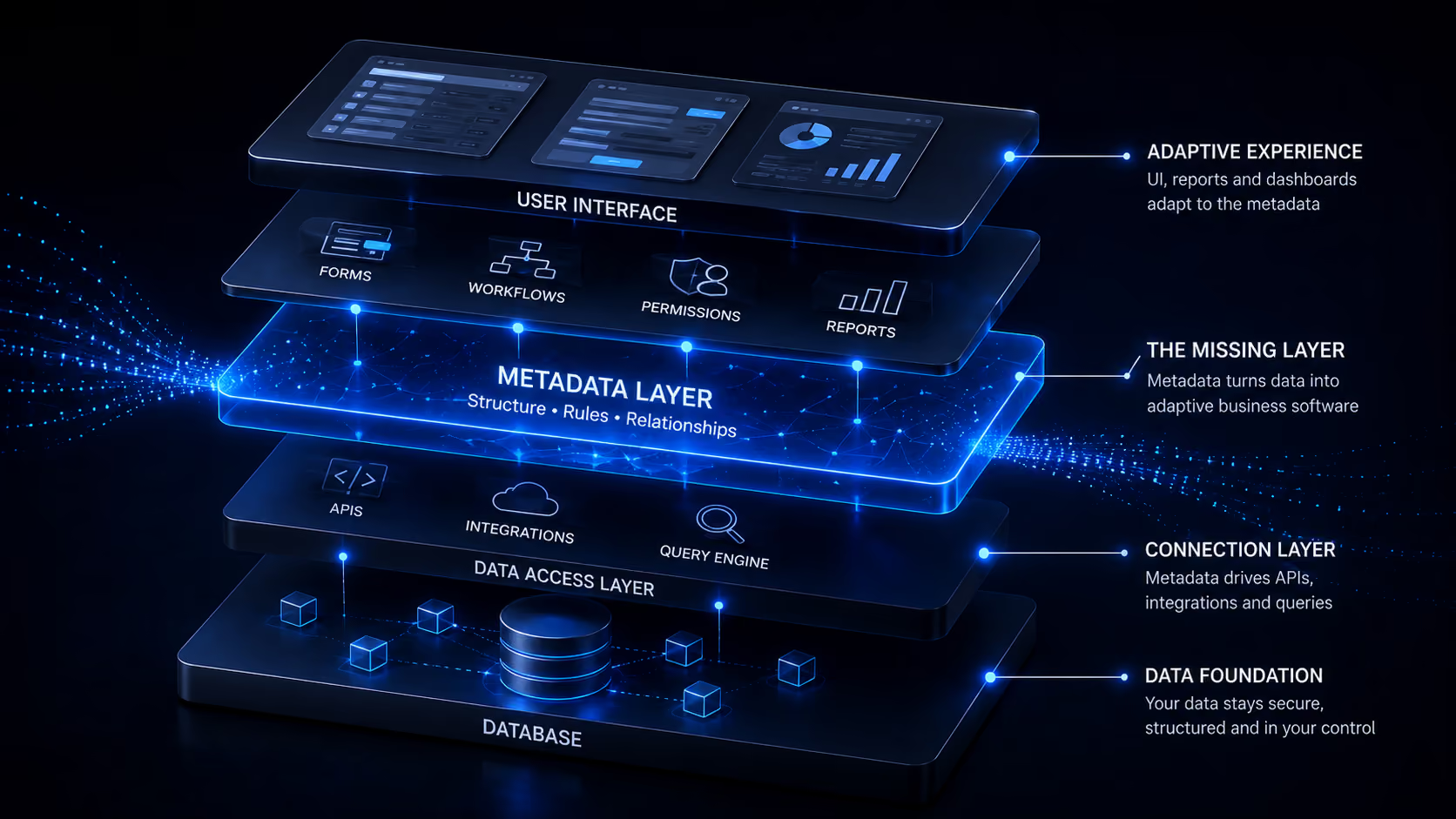
Metadata-driven systems can describe data structures, workflows, permissions and user interfaces using structured definitions rather than hard-coded application logic.
Instead of rewriting software for every variation, the platform adapts its behaviour through metadata.
Developers continue building robust platform capabilities.
Consultants continue designing effective business processes.
The balance simply shifts away from one-off customisations towards reusable architecture.
Looking Beyond Traditional ERP
Business software has evolved enormously during the past four decades.
Cloud computing removed many infrastructure challenges.
Low-code platforms accelerated development.
Artificial intelligence is changing how software is designed and configured.
The next major step may not be another generation of larger ERP systems.
It may be platforms that continuously adapt as businesses evolve.
That would reduce the need for disruptive replacement projects and allow organisations to improve their systems incrementally rather than rebuilding them every decade.
Conclusion
ERP projects do not fail because organisations lack capable people or because vendors build poor software.
Most difficulties arise because businesses evolve faster than traditional enterprise software was designed to accommodate.
As technology continues to mature, the opportunity is no longer simply to deliver ERP projects more efficiently.
It is to rethink how business software is designed in the first place.
The future may belong to platforms that evolve continuously alongside the organisations they support.